Beach Cleanup · Caribbean Cleanup
The Gathering — February 15–22, 2027
The Gathering week runs February 15–22, 2027, on the Honduran coast from Tela to the Río Leán. The week works the course blocks day by day. Saturday, February 20, 2027 is the line day.
This is not only a beach cleanup. It is a town beautification process. It is a total community support project. Its mission includes bringing additional tourism to one of the most beautiful and needy communities in the world, and tourism in that direction supports local families with new jobs. The chain is one chain, stated plainly: cleanup → beautification → tourism → jobs. Clean ground comes first. A beautified town is the work that follows. Tourism is the direction the work serves. Jobs for local families are the end the chain is built toward. Local families are the owners and the beneficiaries of the whole chain.
This is also a movement — the $1 Army. People come together across ethnicities to do this work: Black, White, Hispanic, and the Garifuna communities who host this shore, working side by side in the same line, on the same day, under the same count. No visitor numbers are promised here. No outcome is guaranteed here. The mission, the direction, and the work are stated. The record will publish what the work does.
The Program — the whole week, not only the work
The week is shaped in three parts, every day: work mornings, heritage and music evenings, and kids on the beach throughout.
Work mornings. The line stands up in the morning, while the day is young. Blocks work their kilometers, bags move to the weigh stations, and the count builds in the open.
Evenings — heritage and music. Live music stands in the evenings, all the way through the event. The community leaders are brought in, and the community presents its own heritage like no one has ever seen it. This is community-led, stated plainly: the organization hosts. The heritage is presented by the community itself. It is never performed by us.
Kids on the beach throughout. Activities stand lined up for kids on the beaches through the week, alongside the work and alongside the evenings.
A vacation at the same time. The week is a vacation at the same time as it is a work week. Visitors come and see how the Garifuna people live — in their own communities, on their own shore, presented by the community itself.
The meaning of the event, stated in this copy: Whites, Blacks, and Hispanics together — nations together — for one goal, a clean ocean.
The line
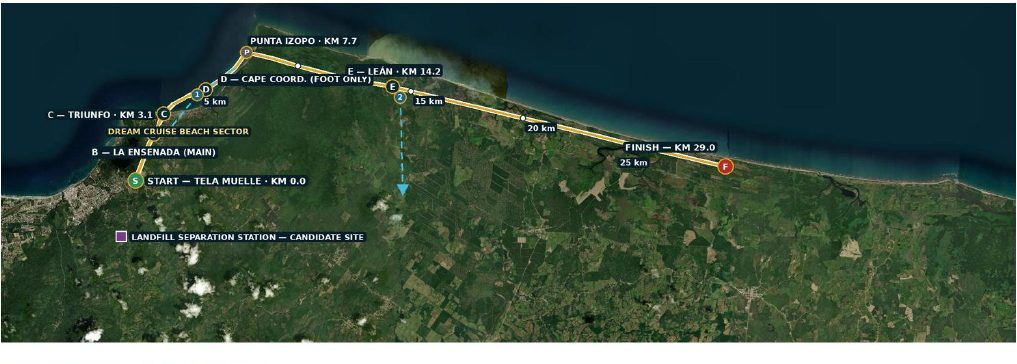
29.0 km — MAP-MEASURED. The line runs from the Tela muelle at KM 0, east through Tela Bay, past La Ensenada and Triunfo de la Cruz, around Punta Izopo, and east to the Río Leán mouth at KM 29.0.
This line is map-measured from satellite imagery. A November 2026 GPS survey walks the line, fixes the start pin inside the bay so the measured line is exactly 29.0 km, sets all 29 block boundaries, and confirms station sites and access points on the ground. The November GPS survey note stands with this section until that survey is complete.
Five volunteers per kilometer
The line stands in 29 one-kilometer blocks, numbered west to east. Block 1 at Tela. Block 29 at the Leán mouth. Every block is held by a team of five volunteers, with one block captain in addition to the five. Blocks 1–5: Tela Bay sectors, urban beach. Blocks 6–10: La Ensenada home shore, headquarters ground. Blocks 11–14: the beach line to Triunfo. Blocks 15–17: Punta Izopo sanctuary edge — hand crews only, no machine enters. Blocks 18–29: the buffer shore to the Leán. The mouth blocks are hand ground. Every block carries a rally and shade point at its landward edge — water, shade, bag stock, and the collection point marked with the block number.
Weigh stations
Six weigh stations stand along the line. A Tela. B La Ensenada — MAIN, headquarters and the count board. C Triunfo. D park entrance. E Arizona track head, forward headquarters for the eastern line. F Leán field station at the finish. Every station scale is checked with certified test weights before the first load. The check is photographed with the station number and date card in frame and logged in the station book. Numbered bags by sector series stand in paper station books as the book of record, mirrored at headquarters on the hour. The count board at Station B updates on the hour. Independent countersignatures stand at 12:15. The single announcement stands at 12:30.
The haul chain
Block collection point → trailer → weigh station (the record) → truck → landfill separation station (the sorting) → buyers / the landfill cell (the end).
A bag is numbered at the block, weighed at the station, sorted at the landfill station, and receipted at its end. Nothing collected sleeps on the beach. Tractors and trailers haul the filled bags to the weigh stations. Trucks remove the loads to the landfill. Everything is weighed as it runs.
Landfill separation
The separation station stands at the municipal disposal site, under written municipal agreement. Trucks tip into a marked receiving lane. Loads are spot-checked against the truck receipt. The sorting line runs on tables, by hand, into category bays: PET plastics · rigid plastics · glass · metal · residual · hazardous — sealed container, crew-lead handling only. A baler compresses PET and rigid plastics for the buyers trucks. Recyclables leave by buyers and collectors trucks, weighed and receipted. Residuals enter the landfill cell under the municipal agreement, weighed at receiving. The published number separates honestly into recovered and landfilled. The hazardous stream is sealed and signed over to the municipal and health-authority channel. Natural material — driftwood, seaweed wrack — is not waste, is never weighed as collected waste, and does not enter the station.
The glasses layer
The whole operation is filmed through AI glasses and tracked every day. Wearers: every block captain, every weigh-station keeper, the segment leads, the landfill station receiving lead, and the President. Each block carries a fixed capture sequence: the opening frame at first light, the work, the loads leaving, and the closing frame at stand-down from the same vantage. The tracking log stands per block per day — block number, captain, team count from the credential ledger, bags out by series, kilos from the station book, capture index. Daily proof cuts publish the same evening. The dataset, published after the week, indexes the capture by block and station. Consent discipline stands in full: volunteers consent at registration, a volunteer who declines is placed where the glasses grammar does not run, no capture is ever directed at a minor, and no directed filming stands over the sanctuary nesting sectors.
Safety and discipline
Crews are the unit of assignment, rotation, and tally. The 45-minute water-and-shade rotation is enforced by captains, staggered inside the block so the line never empties. Minors stand with a guardian only, off the water line, and never inside a machine block. No volunteer enters the surf. River-mouth blocks are bank work in sight of the captain. Machine blocks are flagged, one operator, one spotter, walking pace on shuttle routes. The First Pass runs at dawn, with the President riding at the head of the home segment before the massed line deploys.
The fallback — printed on the page, in the open
If the buffer-zone authorization for the eastern shore slips past the January training checkpoint, the attempt contracts to a shorter course: La Ensenada, past the home shore and Triunfo de la Cruz, around Punta Izopo, and toward Arizona — approximately 20–25 km, run with the same blocks, the same five-per-kilometer density on its shorter line, the same weigh stations and proof stack, the same landfill separation station, and the same glasses layer. The claims that stand under the fallback ride on continuity and proof. The full 29.0 km line then re-stages as the Rolling Line next count day, once the authorization and the eastern staffing are real. The line that runs is the line that was authorized. The record it makes is the record that was designed.
La Ensenada garbage-truck campaign
Clean sand needs a truck behind it. The garbage-truck campaign rides the Beach Cleanup designation with its own tag.
Give to Beach Cleanup Give to the garbage-truck campaign
Volunteers Plan your trip Book your own room
Dollars in
$0 raised at build, from the book only. The $32,000 garbage-truck campaign goal stands in its own campaign book. Tag: ?src=beach.
Built
Nothing built yet. Nothing reads built before it stands.
Published
Book opens with this build — October 27, 2026. A dated log line follows every dollar movement and every stage completion.